Showing posts with label vintage. Show all posts

Sunday, January 24, 2010

Happy 26th Birthday Macintosh!

DATELINE: January 24, 1984

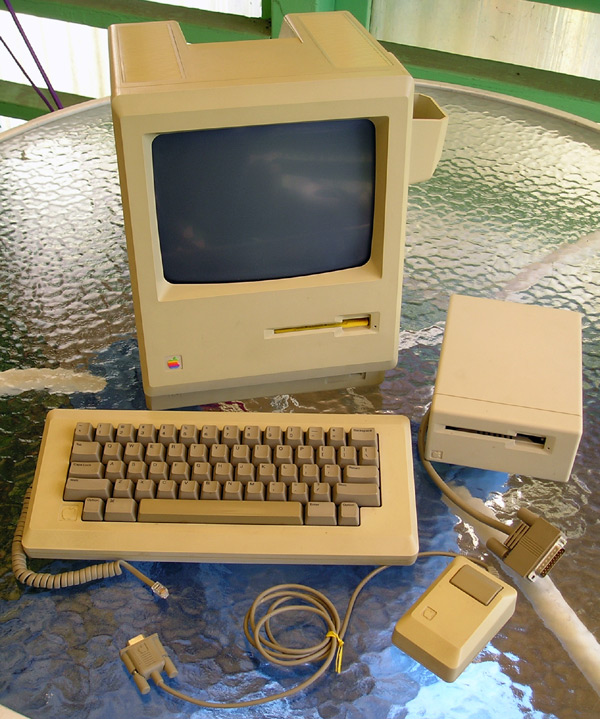
Apple Computer releases

The Macintosh Computer


Friday, January 22, 2010

1984 Macintosh Super Bowl Ad

DATELINE: January 22, 1984

the now famous 1984 ad during the Super Bowl.


Sunday, January 3, 2010

Happy Birthday Apple Inc.

On January 3, 1977 Apple Computer was incorporated.


Happy Birthday Apple

from all of us in the Mac World.


READ: Interview with Rob Janoff, designer of the Apple logo
by Ivan, Creative Bits

Wednesday, October 17, 2007

Mini vMac for Mac OS X

"The goal of the Mini vMac project is to help preserve software made for early Macintoshemulators that allow such software to be used on modern computers. The first member of this family emulates the Macintosh Plus.

Mini vMac began in 2001 as a spin off of the program vMac. It was originally intended to be of limited interest, a simpler version to serve as a programmers introduction to vMac. But vMac hasn’t been updated in many years, so Mini vMac may now be considered its continuation.

The “Mini” in the name now means that each emulator in the family is as small and simple as possible. The meta program and data that generate the emulators (the Mini vMac build system) is rather bigger. Besides the Macintosh Plus, there are also emulations of the Macintosh 128K, 512K, 512Ke, SE, Classic, and SE FDHD. Work is in progress on Macintosh II emulation. There are also numerous other options.


Mini vMac requires a ROM image file to run, and so can be legally used only by those who own a 680x0 based Macintosh. This leads to the question, if you need to own the real computer to use it, what is the use of the emulator? First, a real Macintosh won’t last forever. It is common for the power supply to fail. It is still legal to use the emulation after the real computer breaks. And second, the emulation is more convenient than the real thing. It is much faster (on modern computers) and you can use a better screen, keyboard, and mouse. And it is easier to transfer files between the modern computer and the emulator."

Downloads are available for Mac os8, os9 and Mac OS X, Windows, Linux and more.
from sourceforge, or course

Thursday, August 9, 2007

Apple II based cluster

Because you can!


8 Apple //e main boards net-booted by a more equipped Apple //e.


Saturday, July 14, 2007

The Macintosh Computer 1985

An in-depth look at the Apple Macintosh computer, available software and hardware add-ons.

Guests: Joanna Hoffman, Apple; Bob Foster, Telos Software; Lee Lorenzen, Digital Research; Ben Wiseman, InfoCorp; Gary Kildall, DRI; Larry Tesler, Apple

Products/Demos: Apple Macintosh, MacProject, FileVision, GEM DrawJazz

SEE: The Macintosh Computer (3/12/1985)

This movie is part of the collection: Computer Chronicles
available from the Internet Archive

Thursday, January 5, 2006

WebSE - System 7.0 Sim

This is an amazing replica of what Mac System 7 was like on a Mac SE computer, and so much more...


The WebSE - System 7.0 Simulation
© by Oliver Soehlke & Lukas Pajonczek


Alice in MacWorld 1982

"You've got to see the new game that Steve Capps wrote", he told me while he was connecting his hard drive up to my Lisa.


The screen turned black and then, after a few seconds delay, a three dimensional chess board in exaggerated perspective filled most of the screen. On the rear side of the board was a set of small, white chess pieces, in their standard positions. Suddenly, pieces started jumping into the air, in long, slow parabolic arcs, growing larger as they got closer. ..


It ran even better on the Mac than the Lisa, since the Mac's faster processor enabled smoother animation.

Steve Jobs didn't play Alice very much, but he was duly impressed by the obvious programming skill it took to create it. "Who is this Capps guy? Why is he working on the Lisa?", he said as soon as he saw the program, mentioning Lisa with a hint of disdain. "We've got to get him onto the Mac team!"

Unfortunately, Apple never put the promised marketing effort into Alice. They were in a quandary because the market didn't understand the graphical user interface as a productivity enhancement yet; graphics meant games, so the Mac had to live down an initial reputation as being unsuitable for business tasks. Apple didn't exactly want to promote a game for the Mac at the time, no matter how sensational, so Alice never quite reached as wide an audience as it deserved.


Alice

Author: Andy Hertzfeld
Date: June 1982
Characters: Steve Capps, Bruce Daniels, Steve Jobs, Joanna Hoffman
Topics: Software Design, Games, Lisa, Marketing
Summary: The Macintosh's first great game
Revision: most recent of 15

Monday, September 22, 2003

Apple's QuickTake Digital Camera

My first digital camera is
Apple's QuickTake from the 1990's

G3 Desktop 266:
Install QuickTake for Power Macintosh; QuickTake Software, QuickTake Desktop Access Software. Able to read QuickTake pictures.

G3 Mini Tower 300 (Beige):
Install QuickTake for Power Macintosh; QuickTake Software, QuickTake Desktop Access Software, Geoport. Able to read QuickTake pictures, and connect to camera. Copying to desktop froze computer; restart...


Sunday, July 27, 2003

Mac SE/30 now with SuperClock!

I picked up an old SE/30 (System 7.1, 16 MHz) in the garbage pile outside of a Church sale and installed the following today;

SuperClock! 3.9.1 (1991)
After Dark 2.0t (1990)
Amazing (1984)
SCSI Tools (1987)
Disk First Aid 7.0 (1991)

9" of black and white screen joy, almost just like my first Mac.
SEE PREVIOUS POST: My First Mac

Sunday, September 19, 1993

My First Mac

An updated version replaced the Mac 512K and debuted as
the Macintosh 512K enhanced on April 14, 1986.

• 8 MHz Motorola 68000 processor
• 512 KB DRAM
• 16-bit data bus
• 128K of ROM
• 800 KB internal floppy single-sided disk drive
800 KB external floppy disk drive (M0131)
LocalTalk network 3-pin Mini-DIN connection
Macintosh Keyboard (M0110)

The original 512K could accept Macintosh system software up to version 4.1; System Software 5 was possible if used with the Hard Disk 20; With the OEM 800K Drive and ROM upgrade kit a 512Ke could accept up to System 6.0.8.

The LaserWriter became available for the first time shortly after the 512K's introduction.

The 512K was the earliest Mac capable of supporting Apple's AppleShare built-in file sharing network, when introduced in 1987.


Macintosh 512K and accessories

by Ellen Levy Finch (Elf | Talk) March 24 2004